Pipeline That Compounds: A Revenue Engineering Framework
Campaigns expire. Pipeline compounds. The architecture for replacing rented MQL machines with owned infrastructure, marketing-as-code, and answer-engine visibility.
When a CRO asks me to look at their pipeline problem, I find the same thing. The demand gen motion is running, but nothing it produces lasts. Campaigns fire and expire. Headcount turns over and takes the playbooks with it. The team is busy and the pipeline is thin.
The revenue motion is rented, not owned. Every input decays the moment budget stops, leaving a cost line where a system should be.
Revenue Engineering treats go-to-market as infrastructure you build, version, and own rather than a budget you burn. The assets you ship today produce pipeline in eighteen months. Pipeline that compounds, not campaigns that expire.
The structural failure of campaigns that expire
Campaigns fail because every dollar buys a single, decaying outcome. Paid clicks stop the instant spend stops, rented audiences belong to the platform, and MQL volume rewards activity over revenue. The model has no balance sheet, only a cost line that resets to zero each quarter.
The campaign model runs on three borrowed assets, and you control none of them.
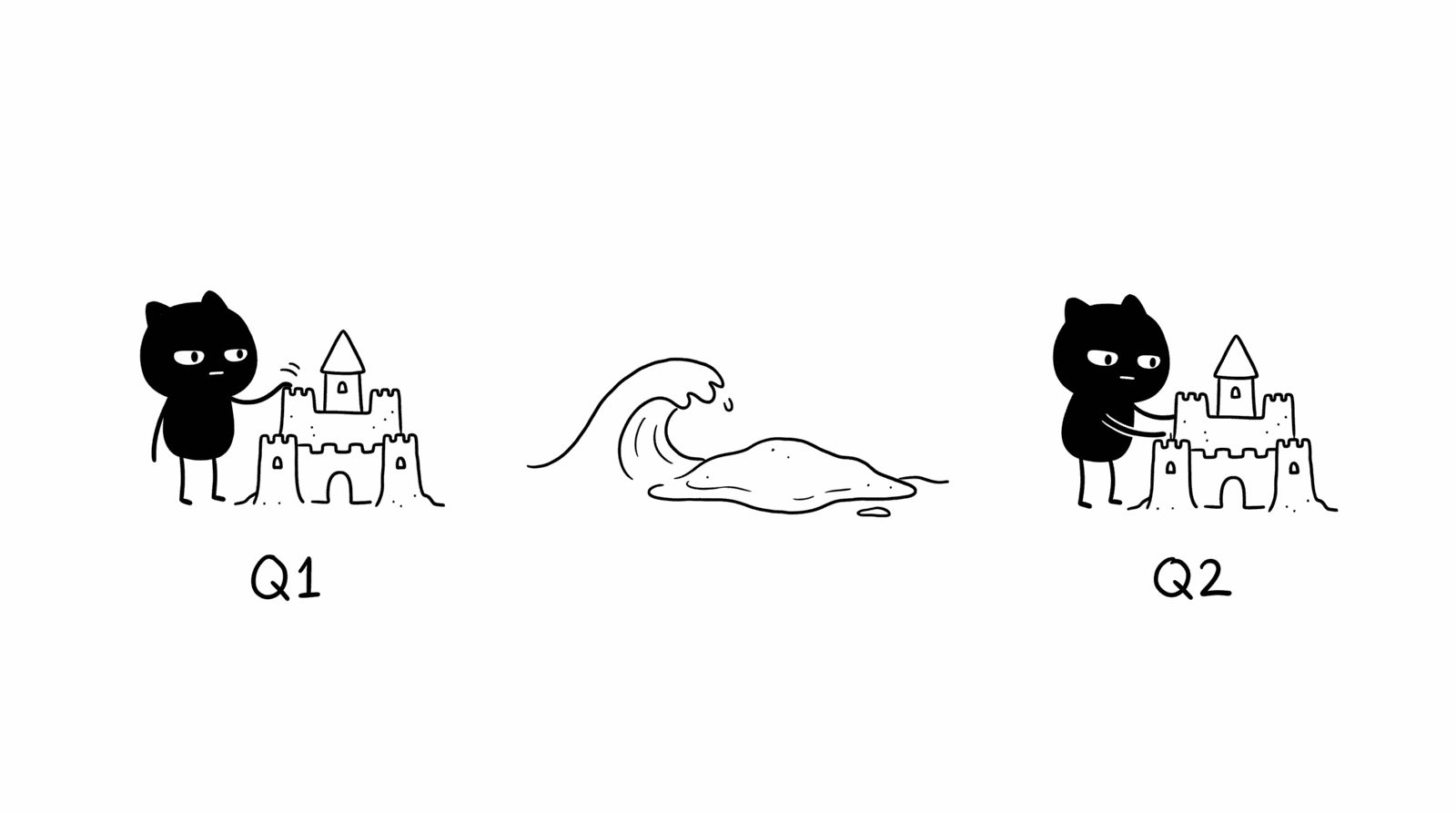
A campaign spends its value at the moment of delivery. A LinkedIn ad served in Q1 contributes nothing to Q3. The work does not accumulate. You rebuild the same machine every quarter and call the rebuild performance.
The architecture of compounding pipeline
Compounding pipeline runs on owned assets that appreciate: content engineered for answer engines, go-to-market logic in version control, and infrastructure you host yourself. Each asset shipped lowers the cost of the next acquisition and keeps producing after the work stops.
I build this across three layers.
Foundation: owned data infrastructure
Before any play fires, the data layer has to be clean and current. CRM hygiene, enrichment pipelines, ICP scoring, data architecture. Every downstream play runs on this layer. Bad data here means bad signals and bad execution at every layer above it.
Most GTM failures I diagnose start here. The enrichment pipeline is missing. The CRM data is stale. Accounts route to the wrong rep. The team runs everything manually because no one built the foundation that automation requires.
Modelling: intelligence from first-party signals
The Modelling layer turns clean data into prioritised targets. ICP scoring, intent signals, propensity models built from patterns in your own won and lost deals rather than vendor assumptions.
A scoring model trained on your closed-won data outperforms any third-party intent tier because it reflects your actual buyers. You build it once. It runs on every new account without intervention.
Activation: infrastructure that runs without intervention
The Activation layer executes on the intelligence Modelling produces. Signal-triggered outbound, ABM plays, inbound routing, CRM-native personalisation. No one presses a button. The system catches the signal and fires the play.
Go-to-market logic lives here as code. Routing rules, scoring logic, enrichment waterfalls, and attribution all sit in version control. A rule written once executes on every lead. When the rule changes, you change it in one place and the whole system updates. Nothing degrades when the person who built it leaves because the logic sits in the repo.
Answer Engine Optimisation belongs here too. Search now resolves inside the answer. Google AI Overviews, Perplexity, and SearchGPT synthesise a response and cite their sources. If your content is the citation, you sit at the exact moment of intent, paid for once. A well-structured note written this quarter gets cited for years.

GTM Engineering vs traditional Demand Gen
Traditional demand gen optimises for lead volume on a quarterly budget cycle using rented SaaS and paid media. GTM engineering optimises for pipeline that compounds, measured over years, built on owned code and infrastructure.
| Dimension | Traditional Demand Gen | GTM Engineering |
|---|---|---|
| Primary metric | MQLs, cost per lead, campaign CTR | Sourced pipeline, compounding CAC, content citation rate |
| Time horizon | Quarterly campaign cycles | Multi-year asset accumulation |
| Core asset | Rented audiences, purchased lists | Owned content, owned code, owned infrastructure |
| Distribution | Paid media, gated forms, SDR cold outreach | AEO citations, organic answer-engine presence, inbound intent |
| Tooling | Marketing automation SaaS, ad platforms, intent vendors | Version control, CI/CD, self-hosted agent orchestration |
| Logic lives in | A marketer’s head and a SaaS UI | A versioned repository |
| Cost behaviour | Resets to zero each quarter; linear with spend | Marginal cost trends toward zero per new asset |
| What happens when spend stops | Pipeline flatlines within one sales cycle | Assets keep producing pipeline for years |
| Failure mode | Volume without revenue; MQL-to-SQL blame loop | Slower to start; requires engineering discipline up front |
| Scaling mechanism | Add budget, add headcount | Add code, add agents |
| Who owns the audience | The platform | You |
GTM engineering is slower to start. You will not see a spike in week two. Building owned infrastructure requires up-front work that a credit card and an ad account skip. Teams that need a number this month reach for campaigns and stay on the treadmill. Teams that want a number every month for the next three years build the system.

Starting the build: diagnosis before architecture
Before any system gets built, I map how revenue flows through the business: where it stalls, what data exists, what is missing. Most underdelivering GTM projects were misdiagnosed at kickoff. The build was correct. The brief was wrong.
From there, two things to ship in parallel.
Convert the highest-friction manual workflow your team repeats into code. Lead routing, enrichment, or list cleaning, pick one and write it as a function in a repo. It executes on every record from that point forward, without a human in the loop.
Take the question your best prospects ask on every first call and answer it as a structured note: question as the heading, the definitive answer in the first forty words, entities and related concepts underneath. It gets cited long after the ad budget that would have answered the same question is spent.
Every commit makes the system more capable. Every note widens the surface area answer engines can cite. The work accumulates and the pipeline compounds.